Official-source signals
AI adoption and trust signals (2026)
Snapshot of adoption velocity and trust risk for AI coding workflows, based on large-sample developer and platform reports.
Updated 2/18/2026 · 12 signals · 7 sources
Download and share
Share this report to help teams cite one canonical source and link back to The Stash.
Key adoption and trust signals
- Signal
GitHub Octoverse 2025
GitHub surpassed 180 million developers (+50M in one year)Developer growth signals expanding global software participation and opportunity.
- Signal
GitHub Octoverse 2025
4.3 million projects on GitHub now use AIAI-native and AI-assisted development is becoming standard at project level.
- Signal
JetBrains Developer Ecosystem 2025
JetBrains surveyed 24,534 developers across 194 countriesLarge global sample size provides a broad signal on tooling and workflow behavior.
- Signal
JetBrains Developer Ecosystem 2025
85% of developers regularly use AI toolsRegular AI usage confirms broad integration into mainstream engineering tasks.
- Signal
JetBrains Developer Ecosystem 2025
62% rely on at least one AI coding assistant, editor, or agentAssistant reliance is now common enough to influence baseline team tooling decisions.
- Signal
JetBrains Developer Ecosystem 2025
68% expect AI proficiency to become a job requirementAI capability is increasingly treated as a core professional skill in software roles.
- Signal
Stack Overflow 2025 survey press release
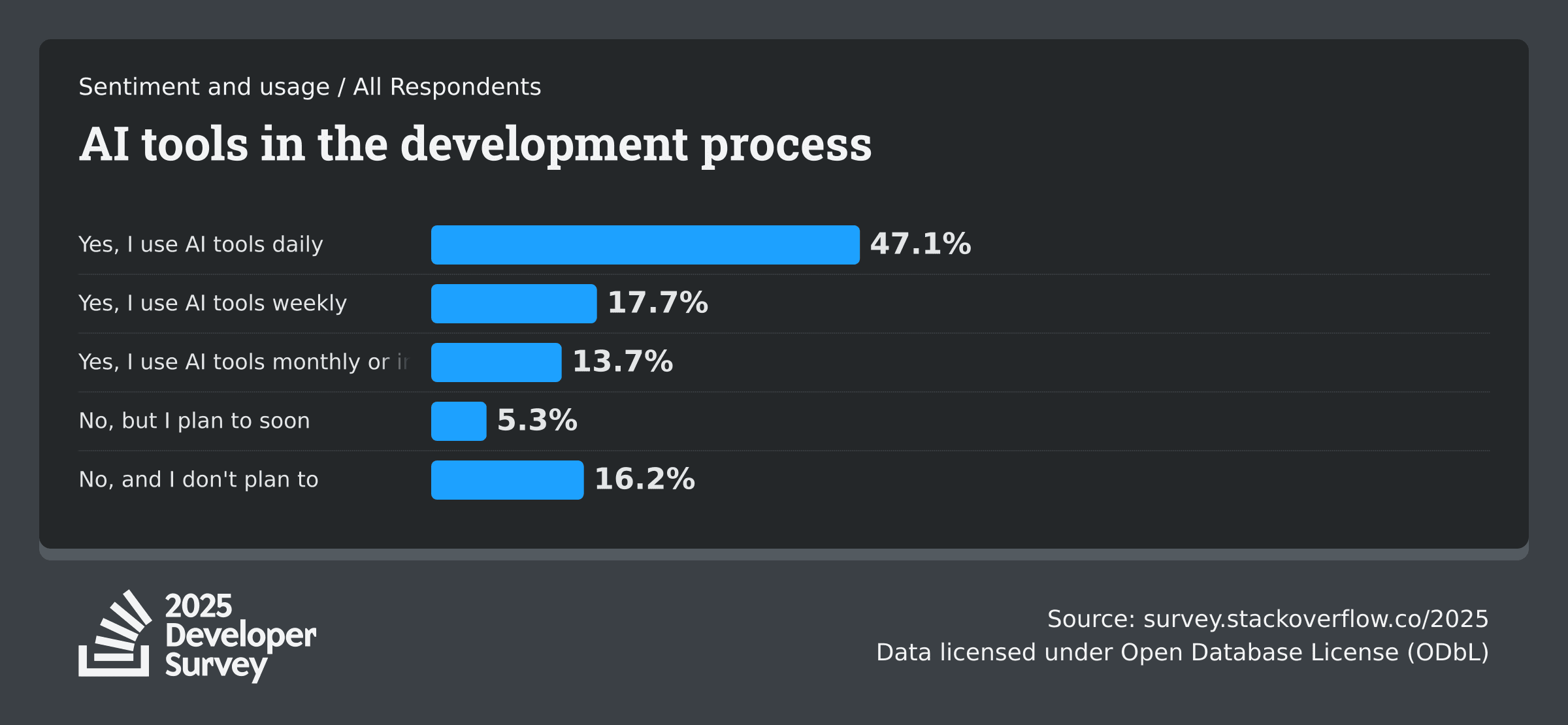
51% of professional developers use AI tools dailyDaily AI usage shows sustained workflow integration rather than occasional experimentation.
- Signal
Stack Overflow 2025 survey press release
46% of professional developers do not trust AI output accuracyTrust and verification remain critical, so teams still need strong review and quality guardrails.
- Signal
Stack Overflow 2025 survey press release
AI agents: 31% using now, 17% planning, 38% no plansAgent adoption is growing but not universal, indicating mixed readiness across teams.
- Signal
Stack Overflow 2025 survey press release
Among AI users: ChatGPT 82%, GitHub Copilot 68%Tool share data shows where user familiarity is currently concentrated.
- Signal
Stack Overflow 2025 survey press release
AI IDE usage: Cursor 18%, Claude Code 10%, Windsurf 5%Specialized AI coding environments are gaining share relative to traditional IDE-only workflows.
- Signal
Stack Overflow Developer Survey 2025 (AI section)
84% of developers use or plan to use AI toolsLatest Stack Overflow Developer Survey 2025 signals AI has shifted from experimental to mainstream in dev workflows.
Report visuals and infographics
July 29, 2025
Largest annual developer sentiment dataset with detailed AI usage, trust, and workflow impact signals.
- 84% of developers use or plan to use AI tools in their workflow.
- 51% of professional developers report daily AI tool usage.
- 46% of professionals say they do not trust AI output accuracy.

November 6, 2025
GitHub's annual state-of-development report tracking global contributor growth and AI adoption at project level.
- 180M+ developers are now on GitHub globally.
- 4.3M projects on GitHub now use AI.
- 1/sec new developer joined GitHub throughout 2025.

2025 report
DORA's annual software delivery research covering AI usage, platform engineering maturity, and delivery performance.
- 90% of professionals use AI in day-to-day work (DORA 2025).
- 90% of organizations report using an internal developer platform.
- 76% of organizations now have a dedicated platform team.
What this means for end users and buying teams
- Adoption is no longer optional: baseline team workflows should assume AI-assisted coding.
- Trust remains the bottleneck: organizations need test gates and review checklists before shipping AI-generated output.
- Tool familiarity is concentrated in a small set of products, so migration friction is often lower than expected.
- As AI usage becomes a job-level requirement, publish repeatable onboarding docs for your chosen tool stack.
Benchmark audience
Get official-source benchmark reports in your inbox
Monthly benchmark brief with verified data points, new infographics, and source links you can cite in strategy docs, stakeholder updates, and tool evaluations.
Protected by reCAPTCHA. Google Privacy Policy and Terms of Service apply.